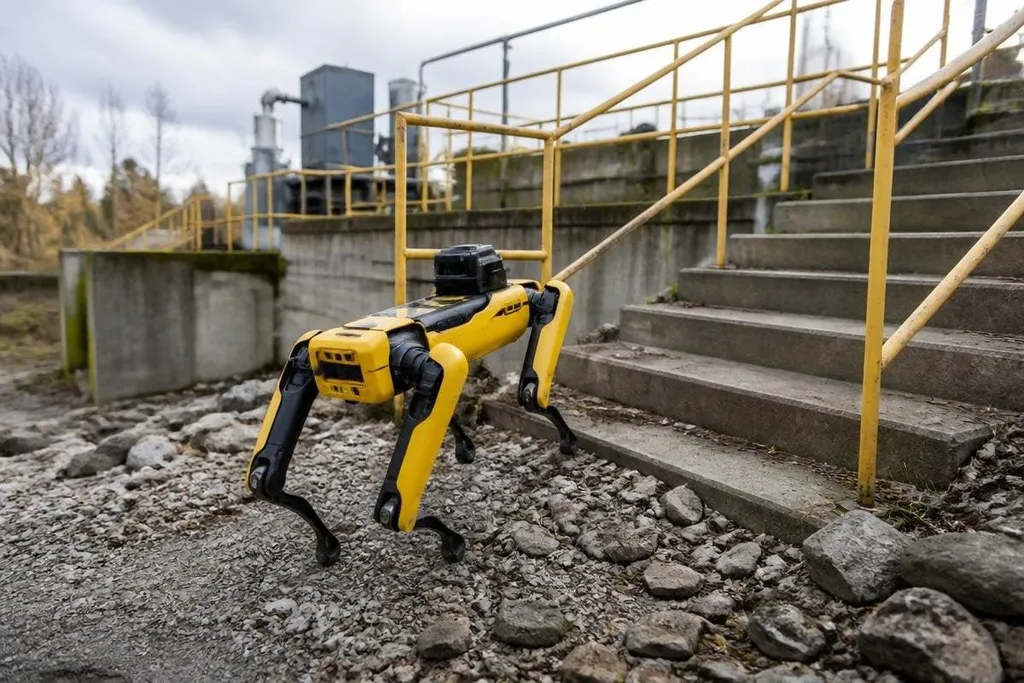
A robot dog can walk over rough ground, carry cameras, and return to a charging point without a person holding it. The harder test is finding work where those abilities save enough time or reduce enough risk to justify the cost.
- Best near-term work: inspection, mapping, and patrols in places that are unsafe or costly for people.
- Main limits: battery life, reliable foot placement, weather, and safe operation near workers.
- What decides the market: a clear task, measured results, and a repair plan.
The work will come before the shape
The four-legged form helps on stairs, gravel, grass, and broken floors. That makes robot dogs useful in places where a wheeled robot may stop, but legs also add motors, joints, sensors, and control software that all need care.
A company buying one won't pay for walking alone. It will pay for a job such as reading a gauge, checking a pipe, building a map, or sending video from a site where a person would face heat, height, water, or moving equipment.
That job needs a repeatable result. If the robot finds the same fault that a technician would find, records its location, and sends the data in a usable form, the walking hardware has a reason to be there.
Sensing will shape the next step
Robot dogs can carry cameras, microphones, thermal sensors, and LiDAR. LiDAR measures distance with light pulses, so the robot can build a map and judge the space around its feet.
More sensors don't fix a poor task. A thermal camera may show a hot motor, but a technician still needs to decide if the reading points to a fault, a normal load, or a bad measurement. The useful system will connect the sensor reading to a clear work order.
Autonomous operation will also stay limited by the site. During a planned route, the robot may stop when a person enters its path and ask for remote help when the ground or object falls outside its training data.
That last step matters. A worker needs to know when the robot has stopped, why it stopped, and what action is safe. Remote control can cover some gaps, but it adds a person and a communications link to the task.
A robot dog that climbs stairs in a demo still needs a power and repair record before a site manager plans work around it. When you read Robot24.com, look for the robot model, test setting, and date behind claims about field work. Those details matter before battery life and repair time set the robot’s real workday.
Batteries and repairs will set the pace
Walking uses power at every joint. Cameras, computers, wireless links, and payloads draw power too.
A longer route may therefore require a larger battery, a spare battery, a charging station, or a person who can move the robot between jobs.
The repair plan matters as much as the purchase price. A fleet manager will need replacement legs, seals, batteries, cables, and sensor covers. They will also need a way to check whether a fault comes from hardware, software, or the site map.
Weather adds another test. Rain, dust, mud, cold, and heat can affect traction and sensors. A robot that works in a clean test area may need a different enclosure, cleaning routine, or operating limit at an outdoor site.
The useful future is narrow at first
Robot dogs will probably spread through tasks that are dull, repeated, or unsafe. They won't replace a technician who must repair a machine, make a judgment, or work with a customer. They may reduce the number of routine site visits that require a person to collect the first set of data.
I'd buy one only when the task has a written pass condition and a measured cost for human work. Without that test, the robot risks becoming an expensive camera with legs.
Before a purchase, check these points:
- Name the task: write down the exact inspection, patrol, or mapping job.
- Set the pass rule: decide what data counts as a useful result.
- Check the route: test stairs, loose ground, doors, ramps, and access limits.
- Count human time: include setup, remote control, cleaning, charging, and review.
- Plan recovery: state who collects the robot after a fall or failed mission.
The next useful proof won't be a smoother walking demo. It will be a robot dog completing the same narrow job for weeks, with its battery use, stops, repairs, and human workload recorded.